
Pros and cons
Various systems are available on the market for constructing a Roll-Off Roof. And each can work well depending on the design. But what are the pros and cons of these various systems? We have highlighted several of them here.
📊 Cost Comparison (2.5 x 3 meter observatory)
For an average roll-off roof observatory of 2.5 x 3 meters, approximately 12 meters of rail is required.
With SkyRoof EasyRail, this is combined with 8 EasySliders (4 per side).
| System | Required | Price | Stability | Maintenance | Outdoor suitable |
|---|---|---|---|---|---|
| V-rail + V-wheel | 12m rail + ±12 wheels | €336 – €960 | ★★★★ | ★★★ | ★★★★ |
| Fixed casters | 12m rail + ±12 wheels | €96 – €480 | ★ | ★ | ★ |
| Strut rails | 12m rail + 8–12 trolleys | €640 – €1,800 | ★★★ | ★★ | ★★ |
| EasyRail (SkyRoof) | 12m EasyRail + 8 EasySliders | €1,500 – €2,140 | ★★★★★ | ★★★★★ | ★★★★★ |
👉 Please note: alternative systems often require more wheels to distribute the weight properly, and precise alignment is crucial to prevent issues.
👉 Would you like to know immediately what you need?
V-Rails and V-groove wheels
V-rails and V-groove wheels are often used in linear motion systems, such as machine guides, conveyor belts, and so on. Here are some pros and cons of both:

Advantages of V-rails and V-groove wheels:
- Stability: The V-profile offers excellent stability and resistance to lateral movement. This ensures smooth and precise linear motions.
- High load capacity: Due to the V-profile, V-groove wheels and V-rails can carry significant loads, making them suitable for heavy-duty applications.
- Self-centering: The V-profile helps center the wheels on the rail, resulting in an even distribution of the load and better system stability.
- Durability: The V-shape provides a larger contact surface between the rail and the wheel, reducing wear and extending the lifespan of the system.
Disadvantages of V-rails and V-groove wheels:
- Sensitivity to contamination: The V-profile can be more sensitive to dirt accumulation than other guidance systems, which can lead to reduced performance and wear.
- Potential noise: At high speeds or loads, friction between the wheel and the rail can cause noise. This may be disruptive in certain applications.
- Precision requirements: Due to the accuracy of the V-profile, V-rails and V-groove wheels must be carefully installed and maintained to ensure optimal performance.
- Costs: Compared to some other linear guidance systems, V-rails and V-groove wheels can involve higher costs, especially for high-end precision applications.
- Extra support required to secure the roof during high winds
In general, V-rails and V-groove wheels are suitable for applications where stability, load capacity, and durability are important, but it is essential to consider the specific requirements of the application and the potential disadvantages of this type of guidance system.
Fixed casters
Fixed casters are sometimes used as an alternative guidance method for Roll-off roofs. Here are the pros and cons of fixed casters for a Roll-off roof:
Advantages of fixed casters:

- Stability: Fixed casters can provide good stability, especially if they are well-designed and mounted. They can help distribute the weight of the roof evenly and ensure stable guidance during opening and closing.
- Simple construction: Fixed casters can be relatively easy to install, especially if the roof is already equipped with suitable mounting points or rails.
- Suitable for heavy loads: If correctly dimensioned and installed, fixed casters can carry heavy loads, making them suitable for heavier Roll-off roofs.
Disadvantages of fixed casters:
- Noise and vibration: Fixed casters can produce more noise and vibration than some other guidance systems, especially if they are not properly aligned or lubricated. This can be disruptive, particularly in residential environments.
- Wear and maintenance: Fixed casters can be subject to wear, especially with intensive use or exposure to harsh weather conditions. Regular maintenance, such as lubrication and inspection of the wheels and mounting points, is required to maintain proper operation and prevent premature wear.
- Space requirements: Fixed casters may require more space than some other guidance systems, especially if they protrude beyond the roof surface. This can be a consideration when designing a Roll-off roof, particularly if space is limited.
- Additional guidance: When mounting with fixed casters, you always need additional guidance to ensure the roof rolls evenly.
- Very sensitive to high winds
Overall, fixed casters can be an effective guidance method for Roll-off roofs, but it is important to consider their potential disadvantages and to plan and perform maintenance carefully to ensure optimal performance.
Strut rails and wheels are used as an alternative to ensure guidance.
Pros and cons of strut rails and wheels:
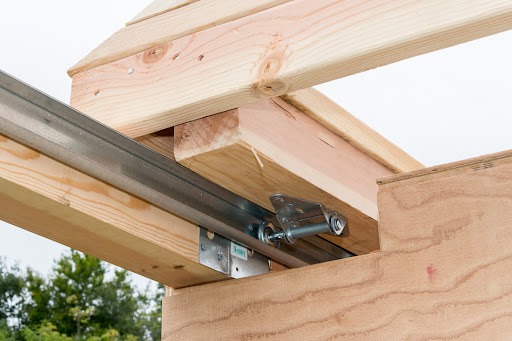
Advantages:
- Stability: Strut rails provide stable guidance for moving parts, such as rolling roofs, allowing for smooth and controlled movement.
- Versatility: Strut rails can be used in various applications, ranging from industrial machinery to rolling doors and Roll-off roofs, making them versatile and widely applicable.
- Durability: High-quality strut rails, made from materials such as anodized aluminum or stainless steel, are durable and resistant to corrosion and wear, ensuring a long lifespan.
- Customizability: Strut rails can often be adapted or custom-made for specific applications, making them suitable for different projects and installations.
Disadvantages:
- Initial costs: High-quality strut rails and wheels can be expensive initially compared to other guidance systems, which may result in higher upfront installation costs.
- Maintenance: Although strut rails are generally durable, they require regular maintenance to maintain optimal performance. This can include cleaning and lubricating the rails and wheels.
- Noise: If improperly installed or maintained, strut rails and wheels can produce noise during use, which can be disruptive, especially in noise-sensitive environments.
- Weight restrictions: Depending on the type and specifications of the strut rails and wheels, there may be limits on the maximum weight they can support. This can affect the applications for which they are suitable.
Pros and cons of the Roll-Off Roof EasyRail and EasySlider:

EasyRail and EasySlider is a combination where the greatest advantage is that the roof cannot be blown off by the wind.
Advantages:
- Easy installation: The EasyRail is designed for simple and efficient installation, featuring pre-drilled holes and mounting points. This makes it easy to assemble the system.
- Weather resistance: The use of anodized aluminum makes the EasyRail resistant to low temperatures, snow, and ice formation. It prevents ice from sticking to the surface, making it suitable for use in various weather conditions.
- Durability: The anodized aluminum construction and stainless steel connectors ensure a long-lasting and robust solution for guiding roofs.
- Smooth guidance: The EasySlider, specifically designed for use with the EasyRail, offers smooth guidance thanks to nylon wheels with ball bearings. This ensures stable and reliable operation of the system.
- Safety: The system provides solid fixation, even in high winds, ensuring the roof remains safely in place and cannot be lifted by the wind.
Disadvantages:
- Maintenance: Although maintenance is minimal, periodic inspection and cleaning are necessary to ensure the system continues to function optimally. This includes removing leaves and other debris from the rails and checking for wear.
- Costs: While the system is durable and efficient, the costs of purchase and installation may be higher compared to some other Roll-off roof solutions. However, it proves to be a more efficient system.
It is important to weigh these pros and cons when choosing rails and wheels for a specific application to ensure they meet the requirements and expectations of your own specific project.


